
Karingal Vet Hospital

328 Cranbourne Road, Frankston, VIC, 3199

P: (03) 9789 3444

Email us

Karingal Vet Call Directions
Book an Appointment

Injured Wildlife

Found injured wildlife and not sure what to do?

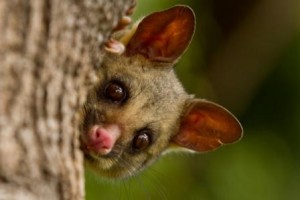
Brushtail_Possum_WildlifeUnfortunately every day around Australia 1000’s of wild animals are injured, orphaned and killed. In a large majority of cases this is through the actions of humans and includes motor vehicle trauma, cat attacks from people not properly confining their pets and in some cases, straight animal abuse.

Much of this injured wildlife is found by members of the public. The following information is provided to assist these people help our wildlife.

Some general rules to follow when dealing with sick or injured wildlife are:

  • Only handle sick wildlife is safe to do so and only rescue an animal if you are comfortable doing so. Be careful when handling native wildlife to avoid injuring the animal or yourself. Some injured animals are dangerous to humans and may bite or scratch when feeling stressed. They are not domesticated like household pets so do not handle them more than is necessary for this reason. Simply place a towel or blanket over the animal and put it in a secure box for transport. Keep the animal warm, quiet, in the dark and away from children, domestic animals and noise.
  • If you find an injured or sick animal it is important to take it to your nearest vet as soon as possible. When you bring an injured animal to our veterinary clinics, we undertake an immediate assessment to determine the animal’s medical condition. Once assessed we can then determine the best course of action including any treatment and placement with a licensed wildlife rehabilitator. There are government regulations relating to the care and protection of injured wildlife which we abide by in all circumstances including the management of declared pest species.
    You will not be charged a consultation fee if you bring wildlife to our clinics.
  • Do not give sick, injured or orphaned wildlife anything to eat or drink. You may be inadvertently feeding unsuitable foods and this may cause further issues with the animal’s health.
  • Do not attempt to care for any injured wildlife yourself, and never plan to keep it as a pet. All wildlife must be handed over to veterinarians, licenced wildlife shelters or licenced foster carers. It is illegal to possess and treat wildlife in Australia without the appropriate training and permits.
  • Record exactly where you found the injured animal. In almost all cases if the animal is rehabilitated and deemed fit for release it will be released as close to possible as to where it was found. This massively increases its chances of survival.
  • Never relocate an animal out of its natural area.
  • Always consider if the animal really needs to be rescued before you try to offer assistance. This is particularly so for many young birds.
  • Always check the pouch of dead marsupials (e.g. kangaroos, possums) as there may be a live, young animal in there.

If you are unable to take the animal to a veterinary clinic then contact one of the following organisations who provide care for wildlife around Frankston and the Mornington Peninsula:

AWARE (Australian Wildlife Assistance, Rescue and Education)
Ph: 0412 433 727
www.awarewildlife.org.au
A volunteer wildlife rescue and rehabilitation organisation operating in Frankston and surrounding suburbs.

Australian Animal Rescue
Ph: 0430 883 083
www.australiananimalrescue.org.au
A rescue organisation based in Cranbourne, Victoria.

Wildlife Victoria
Ph: 1300 094 535
www.wildlifevictoria.org.au
Wildlife rescue group operating 24 hours, 7 days a week Victoria wide.

RACV Wildlife
Ph: 13 11 11
RACV Wildlife Connect is a central 24-hour telephone service for any Victorian motorist who hits or encounters injured wildlife on the road.

Whale and Dolphin Rescues
Ph: 1300 136 017
A hotline regarding whale and dolphin strandings, entanglements and injuries.

WHOMP (Wildlife Help on the Mornington Peninsula)
Ph: 0417 380 687 or 0417 395 883
Some extra advice about some specific wildlife

Bats

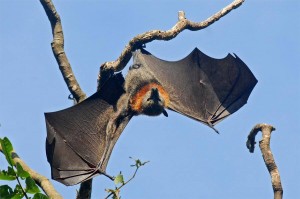
Flying_Fox_WildlifeThere are basically two broad types of bats found in Melbourne. These are the megabats (more commonly known as flying foxes or fruit bats) and the microbats (or insectivorous bats).

It is common for bats to be injured when they are tangled on barbed wire, caught in fruit netting or caught by cats.

DO NOT HANDLE ANY BAT. All bats can potentially be infected with a rabies-like virus called Lyssavirus. Only people vaccinated against this virus should handle bats. More information about Lyssavirus is available here.

While waiting for a bat to be rescued, if safe to do so, cover it with a towel or blanket to reduce stress, prevent injury and protect it from the sun. Contain the bat if possible without handling it.

Do not give the animal any food or water.

If you are bitten or scratched by a bat it is recommended the wound is not scrubbed. Wash the wound thoroughly with soap and water. If available an antiseptic with anti-viral action such as povidone-iodine (e.g. Betadine) should be applied after washing. If you get bat saliva in your eyes, nose or mouth, the area should be flushed thoroughly with water. Contact your doctor or hospital immediately.
Possums and Gliders

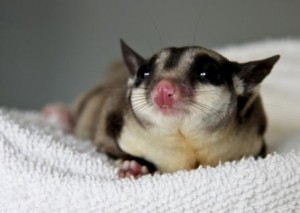
Sugar_GliderPossums and gliders may be creatures of the night but they will often fall foul of motor vehicles and cats.

If you find an dead or injured possum or glider on the road be sure of your own safety before stopping to help. Beware of sharp claws and teeth if trying to handle one of these animals. Large Brushtail Possums can be particularly dangerous and can give a nasty bite or scratch.

If the animal is dead it is important to remember these are marsupials and so always check the pouch of females for live young. If the joey (young possum or glider) is furless do not forcibly remove it from the mother’s teat as this will cause further damage. If the mother is dead and you are comfortable doing so cut the teat as close to mother’s pouch a possible. If not then just transport the dead mother with the joey to the closest veterinary hospital. Hypothermia is a serious risk to these joeys and so keeping them warm with blankets, towels and heat packs is vital.

Do not attempt to give the joey any food or water.
Kangaroos and Wallabies

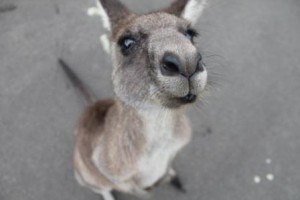
KangarooLike their smaller marsupial cousins the possums and gliders, kangaroos and wallabies are common wildlife cases seen at veterinary clinics.

Stress is a major problem when dealing with these species and so a towel or blanket should be placed over their eyes to reduce external stimulation and lower stress levels.

Injured kangaroos can be quite aggressive so always approach them carefully and from behind so they cannot kick you.

Assisting furless joeys is performed in exactly the same way as described above for possum and glider joeys.
Birds

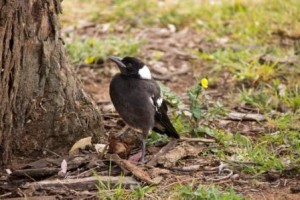
Australian_Magpie_fledglingWild birds are one of the most common types of wildlife presented to veterinary practices and wildlife organisations. Unfortunately many of them are either hit by cars or attacked by domestic pets.

When dealing with an injured bird beware of sharp claws and beaks. Use an old towel or blanket to catch the bird rather than bare hands as this reduces stress on the bird and the likelihood of injury to both the bird and person.

Injured birds should be kept in a well ventilated box that confines it and stops it from flapping its wings to prevent further injuries.

Baby birds are often not in need of rescuing and should be left alone. Many baby birds are in fact “kidnapped” by well-meaning people. This is particularly so for baby Magpies. It is an old wives tale that the parent birds will reject the babies if they are touched by humans. Try and identify the parent bird and nest if possible. If the nest is found simply place the baby bird back in the nest if possible. If no nest is obvious or is out of reach but the parent birds are visible then observe from a distance. If the parent birds tend to the baby then leave it where it is.
Frogs

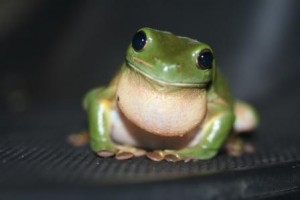
Green_Tree_FrogFrogs may be injured inadvertently when gardening, attacked by cats and often they are found in fruit and vegetables purchased at supermarkets. These so called “banana box” frogs have been transported on the food from farms further north of Melbourne.

Before handling a frog ensure your hands are clean and free from any chemicals. Frog’s skin is very sensitive and will absorb chemicals it is exposed to. Ideally wear wet gloves when handling frogs.

Never relocated a frog that you have found.  A fatal fungal disease called Chytridiomycosis has killed off many populations of frogs across the planet. One of the ways it is spread is by well-meaning people releasing infected frogs into otherwise clean environments.

Gently place any injured or found frog is a small, plastic container with a well secured lid and pour a small amount of water in the bottom to prevent the frog from becoming dehydrated.
Reptiles

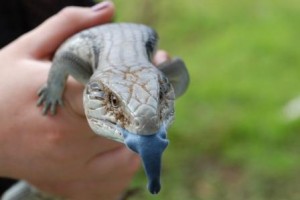
Blue_Tongued_LizardAustralia is home to one of the largest and most diverse populations of reptiles on the planet. It should be remembered this includes some of the most deadly of snakes as well!

Do not handle any snake unless experienced or trained to do so. If you have found a snake contact one of the above wildlife organisations and they will instruct you what to do. This will likely involve getting in touch with a professional snake catcher.

If you have found an injured lizard or turtle gently and carefully place it in a secure box before transporting it to us to be assessed. Karingal Veterinary Hospital has a dedicated team of veterinarians with a special interest in reptiles and amphibians. They are some of the most experienced veterinarians in the country when it comes to treating these types of animals.


Karingal Veterinary Hospital place picture
4.6
Based on 679 reviews
powered by Google
B J profile pictureB J
09:11 30 Dec 25
Very good actually. They treated my Dexter dog extremely well! 💗 I felt love and a genuine care for animals! I will return and his ear lump is now gone with no invasive surgery needed - Thank-you!

For potential new clients - I was quoted thousands at my regular Vet for a procedure, I didn't feel was right for Dexter. All sorted at Karingal.
Carrie Bizz profile pictureCarrie Bizz
04:45 29 Dec 25
We had an emergency with one of our cats recently. She was limping, so I called KVH on the 23rd of Dec and while they were fully booked, they had thankfully just had a cancellation 40 mins before closing. We didn't have to wait long once we got there and our beloved Miss Potato was given excellent care by the 2 vets. Thankfully she didn't have to have any xrays and they found the issue. Once she was diagnosed we got antibiotics and pain medication to give her.
The cost was very reasonable and thankfully after being on her medication and keeping her indoors ( shes usually in and out) she has bounched back to good health!! Shes not limping anymore, and is back playing with her siblings! I am so grateful for the prompt appointment and care that all the staff gave us. Thank you so much.
Tori Blogg profile pictureTori Blogg
06:04 24 Dec 25
Karingal Vet is such an amazing place to take your fur babies. My partner and I had an emergency and had to come in as our Rottie couldn’t walk on his leg and they fit him in on the same day. They were so caring and the staff valued the needs of our baby. Thank you much to all the staff for being so kind and helpful, you all are absolutely amazing and truely care about the health of our animals 🩷
Rene Alt profile pictureRene Alt
21:44 22 Dec 25
Preferred Vet for our beloved pets, highest recommendation from us. When we are worried this clinic is worth the effort, while you wait and see the other customers passing through then you know that you are in the right spot, here everything is well looked after and cared for.
Kira Matt profile pictureKira Matt
07:05 10 Dec 25
Understanding staff who were very knowledgeable about pet behaviour
Sue Putt profile pictureSue Putt
06:50 09 Dec 25
We have only great thing to say about the team at karingal vet hospital, the care and love for animals and their fur family is exceptional, the team saved our precious little girl Bibbish's life. How do you thank people for that!!!! I have always had a fur baby, I have never experience such a delicate team that are truly connected with their patients, everyone at the clinic from the doctors, nurses and the amazing reception staff are beyond perfect, all we can say is thank you which just does not seem enough
Sarah Kilby profile pictureSarah Kilby
06:49 24 Oct 25
Karingal Vet are the best Vet Hospital we have EVER visited (and we've been to our fair share, trust us!). Their collective compassion, kindness, attentiveness and heart is unmatched, but so is their knowledge, skill and professionalism. We cannot fault any of the staff we have come in contact with... and we've met almost all of them. I mean it when I say that 5 stars doesn't even do them justice. We used to have to drag or carry our dogs into vets we've seen previously but now our pups lead us in, tails wagging. They truly are in a class of their own. Sadly, we have faced a lot of pre-existing complex health challenges with our 7-month-old Golden and 10-year-old Labrador and since switching to KVH we have been completely overwhelmed by the quality of care, empathy and love we have all received during every single visit. Thank you, thank you, thank you to the entire team... and although we're not out of the woods yet, we are forever grateful for all you continue to do for our family.
Tanya Bann profile pictureTanya Bann
10:13 15 Aug 25
Always friendly and helpful staff. Amazing vets and vet nurses. Dr Michael Qiu is our usual vet however we saw Ari today and he is also great. They don’t do things not required and always explain things well. The compassion they showed when we had to say goodbye to our 19 year old doggies was incredible and will never be forgotten. I cannot recommend these guys highly enough. We will never go anywhere else.
Sherree Cooper profile pictureSherree Cooper
07:35 12 Aug 25
Absolutely amazing vets and staff they all took wonderful care of our beagle Brooklyn, she had major surgery and they got her and us through it . She was also an epileptic who had many seizures. They always took the time to explain things to us . We will be forever thankful that she had the care she did by them all . Sadly 🐾 we lost her a few
Weeks ago !!! my family and l would highly recommend them !!! Thanks again from the cooper family 😃😃
Adrian M profile pictureAdrian M
22:29 03 Aug 25
We couldn’t be happier with the care our toy Cavoodle, Crunchie, received and continues to receive at Karingal Vet Hospital. The staff were and continue to be incredibly gentle, kind, and thorough, treating Crunchie like one of their own.

A huge shout-out to Kirsten and Dr Ari for their unconditional support and love for our baby boy, their compassion and dedication mean the world to us.

Every visit has always ended in us feeling reassured and at ease. We’re so grateful to have such an amazing team looking after our little one!
Tessa Bottomley profile pictureTessa Bottomley
01:49 08 Aug 24
Best vet!!!! Taken all our dogs and they have always done the most amazing care. From puppy to elderly dog they are just amazing and so caring
Angie Gordon profile pictureAngie Gordon
02:30 02 Aug 24
Wonderful caring staff who have been very understanding to me and my pets.
Emma Brown profile pictureEmma Brown
01:57 30 Jul 24
Friendly, professional and outstanding with my dogs. Highly recommended.
Lynda Nash profile pictureLynda Nash
01:51 22 Jul 24
Great, caring staff and great service.
Always happy with the way my dog is treated here. They are excellent in handling a dog that has high anxiety too.
Aria Kate profile pictureAria Kate
06:38 14 Jul 24
Been taking our fur babies to the team at Karingal for 6 years now and always receive the best treatment. From the reception team, the vet nurses and vets, we always felt well cared for. They’ve always listened to our concerns thoroughly and never made us feel stupid when explaining things.
I always appreciate their follow up calls to double check our pet has been feeling better and that there’s no more issues, I feel like they do genuinely care for my animals :)
Also greatly appreciate the gap only claims for pet insurance, saves a lot of time and money!
John X profile pictureJohn X
05:02 13 Jul 24
Excellent service and top veterinarians. Impressed by the professionalism of the staff.
Natalie J profile pictureNatalie J
01:07 18 Jun 24
We took both our greyhounds here after trying a few vets in the area and they are by far the best. So knowledgeable about the breed and so understanding and patient with their anxiety about going into the consulting rooms. It’s so nice to see your pets being taken such good care of, getting lots of pats and reassurance. Thank you so much!
Cassidy Crouch profile pictureCassidy Crouch
09:30 12 Apr 24
I’ve seen multiple vets and nurses at this clinic since having my first puppy, and every single person has been fantastic. They really pay attention to your concerns and are really thorough with their examinations. I appreciate that they never rush me and take their time to explain things to me. As a first time puppy owner, it’s always great to have things explained in such detail. They are all so friendly and accommodating and I would have absolutely no trouble recommending this clinic to my friends or family.
Emily Stecca profile pictureEmily Stecca
10:23 18 Jan 24
The team at Karingal Vets have been so amazing helping my dog who ruptured his cruciate ligament! Could not have asked for better support during this time pre and post surgery.

Puppy school was amazing too! Highly recommend ☺️

328 Cranbourne Road, Frankston, VIC, 3199

P: (03) 9789 3444

The Karingal Veterinary Hospital is open 6 days a week.

Our hours are

- 8am-6pm Monday-Friday,
- 9am-5pm Saturday,
- Closed on Sundays,

* We are closed on public holidays.